
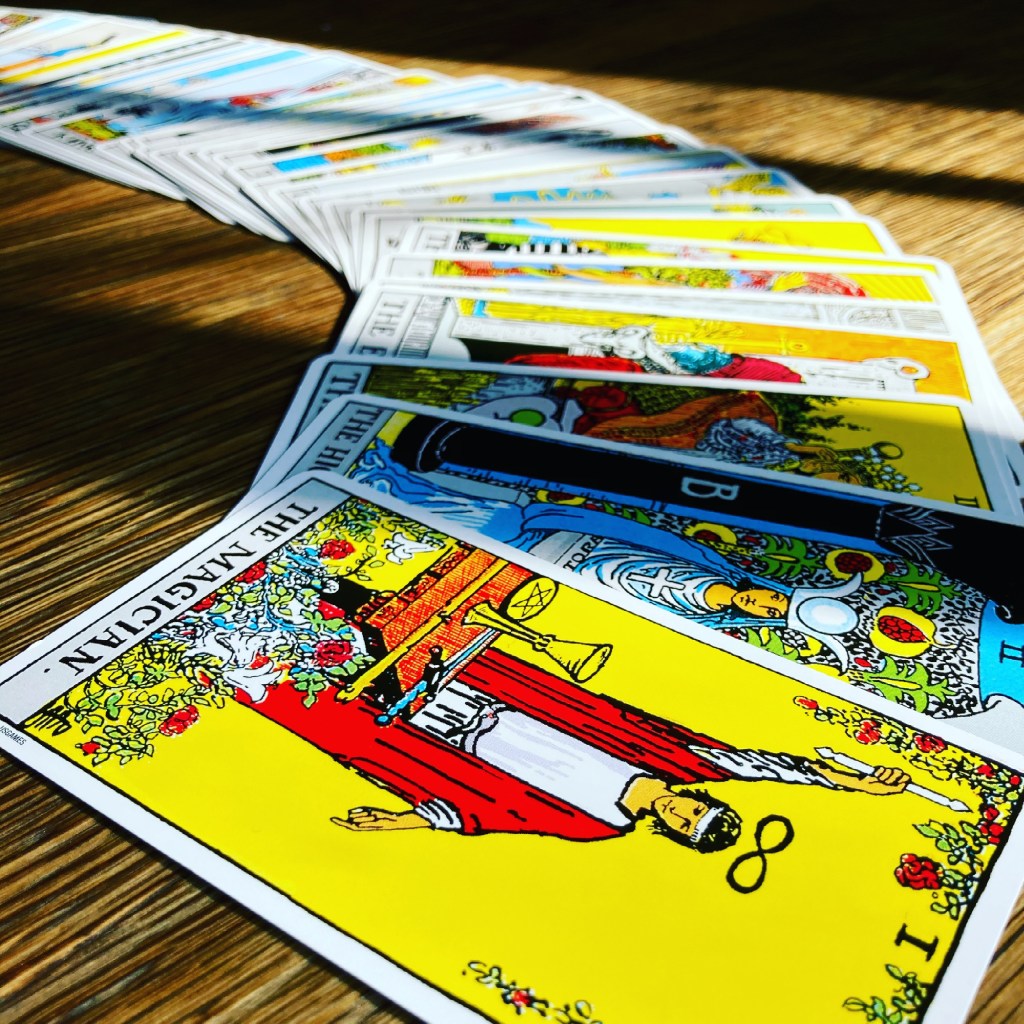
As practitioners of the Tarot know well, there are not only numerous imprints and designs of the Tarot deck available but also thousands of methods for reading, sequencing, and interpreting the cards themselves. As far as I can make out, there is no single right or wrong way of working with the cards to divine the future, but some study is required in order to understand and interpret what each card represents.
I use the classic Rider-Waite-Smith deck (as pictured), itself based loosely on the designs of the Marseilles Tarot. The designs of both have sympathy with some of the earliest known Tarot card illustrations, though this point has been much disputed. What I really love about the traditional R-W-S deck is that its imagery is aligned with the medieval period from which we know the Tarot to have evolved, even if those images were created in the late 19th century.
One long running debate concerns how long Tarot cards have been around for in history. Many scholars, particularly of the Victorian period, claimed the cards had links to ancient Egypt and perhaps even further back into pre-history. We now know of course that they were created in Italy around the 1400s and were used at first as playing cards for a game called tarocchi or tarock. It was only much later – around the 18th century – that they came to be associated with divination.
Does any of this matter? Not really – for the most part, almost all of the cards in the Tarot represent an archetype, and those archetypes are not dependent on time. They are both timeless and universal, coming from our collective unconscious and shared history. My way of interpreting the cards is by using a method grounded in Jungian psychology, with each card symbolizing a specific archetype steeped in meaning.
Perhaps we need some definitions here! In Anthony Stevens’ book On Jung, he describes how the psychoanalyst controversially debunked the theory that humans are born ‘Tabula Rasa’ (blank tablets):
“[For Jung] the whole personality is present, in potentia, from birth and that the environment does not grant personality, but merely brings out what is already there. Every infant is born with an intact blueprint for life, both physically and mentally…”
Anthony Stevens, On Jung
In tandem with this view, Jung proposed the collective unconscious – “primordial images derived from the history of mankind.” These archetypes – from which we have access from birth – are activated within us at different times, for instance the ‘mother’ archetype or the ‘father’ archetype. Jung was careful to denote that these are not inherited ideas or images but rather ‘patterns of behaviour’ that emerge as a response to contact with an archetype, a process called ‘amplification.’
I am oversimplifying what is a complex theoretical approach but the important thing to remember is that archetypes, as Stevens sets out, are “common to all mankind, yet every person experiences them and manifests them in his or her own particular way.” When faced with the ‘mother’ archetype, for instance, one person might be filled with feelings of unconditional love and happiness, while another might feel abject abandonment.
Why is this important? Well, each Tarot deck presents the individual with a different set of archetypes per reading (depending on how you sequence the cards). Some of these archetypes they might have met before, like the Magician or the Devil; others they might not have been exposed to, like the Hermit or Temperance. When they come into contact with an archetype for the first time, it has the potential to activate and amplify within them.
Tarot cards are concerned with divining the future but if you consider that our future actions are determined by feelings or experiences that are not yet known to us – they might have been suppressed in childhood or gone unnoticed by the conscious mind – then confrontation with an archetype can have a deeply profound effect. Bringing subconscious material to the conscious mind can for instance liberate us and force us to confront uncomfortable aspects of ourselves.
Exploring subconscious material in the mind through Tarot and bringing it to light via archetypes may well help us to determine future thoughts, actions, and outlook. It’s both a form of therapy and a way of answering questions about our lives. Let’s face it, when someone sits down to a reading, they ask the cards a question, but do you ever get the feeling that the person already knows the answer themselves?
That’s how Tarot works for me and I find it incredibly useful. As a writer it allows me to surface things about myself that have been hidden and as a result, it enables me to grow and develop. Personal readings can be powerful and profoundly insightful. Tarot can do the same for you!
Further reading:
Anthony Stevens – On Jung (1990)
Sallie Nicholls – Tarot and the Archetypal Journey: The Jungian Path from Darkness to Light (1980)
Robert Wang – The Jungian Tarot and its Archetypal Imagery (2017)
 Paull Blakeman
Leave a comment